

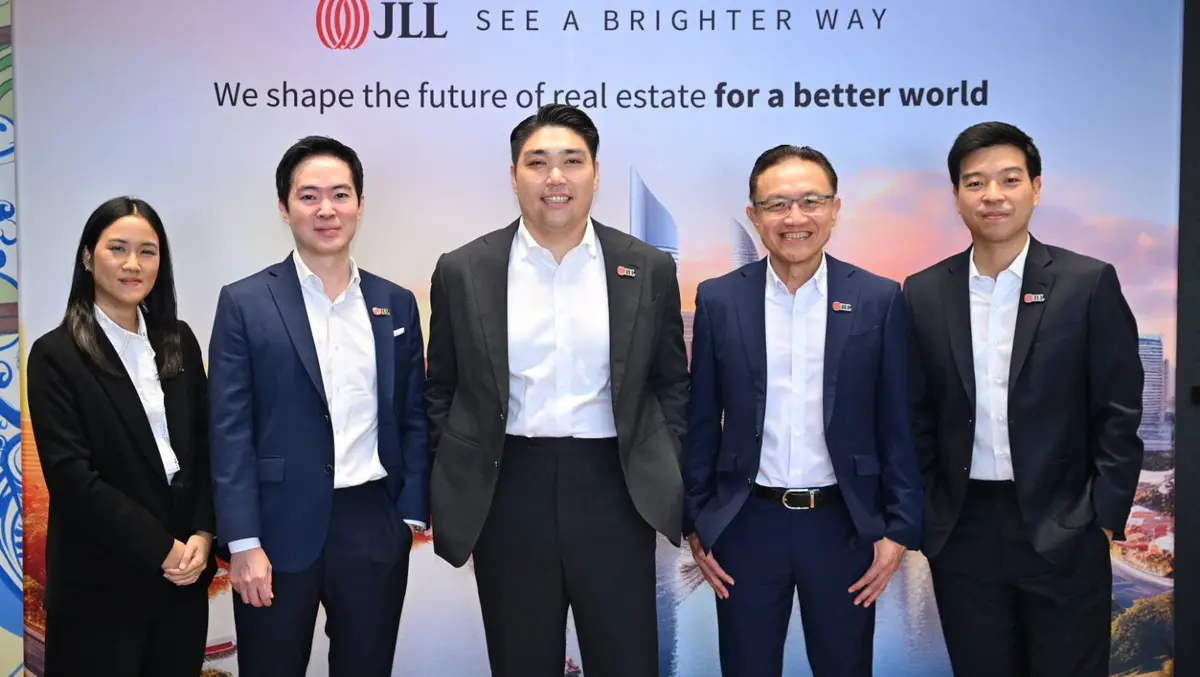
JLL sees Thailand real estate turning selective in 2027
Mon, 23rd Nov 2026 (Today)
JLL says Thailand's real estate market is entering 2027 in a more selective phase, with foreign investment and demand expected to drive growth.
The shift is visible across hotels, offices, industrial sites and land, with activity spreading beyond Bangkok into the Eastern Economic Corridor, Phuket and Phang Nga. Investors are focusing on assets supported by occupier demand, tourism demand and stronger operating fundamentals.
The market is also becoming less centred on the capital. JLL identifies the Eastern Economic Corridor as a core area for the next phase of growth, while resort markets are drawing interest linked to wellness, luxury tourism and high-end housing.
Private wealth is playing a larger role as high-net-worth individuals and family offices increasingly view prime real estate as a safe-haven asset amid global economic and geopolitical uncertainty. Demand is centred on scarce land in Bangkok and resort destinations.
Industrial property is evolving as supply-chain shifts bring new manufacturing investment into Thailand. China+1 diversification is directing capital towards electronics, electric vehicles, advanced logistics and specialised production, while developers are placing greater emphasis on assets that generate recurring income.
Board of Investment figures cited by JLL show foreign direct investment applications rose 62% year on year to THB 1.55 trillion in the first nine months of 2026. Cumulative approvals across the electric-vehicle supply chain reached THB 151.4 billion by the end of August, with battery manufacturing the largest segment.
"Thailand goes into 2027 as a selective market, and that selectivity is healthy. Capital is still arriving, but it is following macro fundamentals and real end-user demand, whether that means a manufacturer committing to a facility in the Eastern Economic Corridor or a hotel buyer underwriting tourism growth in key resort destinations. Foreign investment and foreign demand will be the main drivers of growth next year while Thai private wealth investors are becoming more active. The assets that attract that capital will be the ones that can show clear growth opportunities and why it will last," said Krit Pimhataivoot, Country Head and Head of Capital Markets, JLL Thailand.
Hotel split
In hotels, JLL describes a more divided market following a record 2025 for transactions. Hotel investment volume reached THB 27.6 billion that year, nearly double the 10-year average of THB 13.9 billion.
Average daily room rates have moved above pre-pandemic levels, supported by younger travellers seeking experience-led stays and luxury lifestyle formats. At the same time, the number of buyers has fallen, leaving a smaller group of investors with more cash and stronger conviction.
Assets with Board of Investment promotion remain in demand, particularly where location and distribution are strong. Weaker hotels are falling behind, while leasehold deals are gaining favour as tighter bank financing reshapes how some buyers approach acquisitions.
"The hotel market has split. Well-located assets in prime location with strong distribution system show good performance, and the gap with weaker hotels keeps widening. The buyer pool is smaller than it was, yet the cash-rich and high-conviction investors remain active, partly because bank financing has become harder to secure. That also explains why leasehold deals are gaining ground. For a developer who does not need to underwrite an exit, a long lease can be the more efficient route into a strong location," said Pimpanga Yomchinda, Executive Vice President, Investment Sales, JLL Hotels & Hospitality Group, Asia Pacific.
Office pressure
Bangkok's office market is showing a different pattern. Nearly 380,000 square metres of occupier demand shifted to prime office buildings between 2021 and 2025, three times the pre-pandemic level, but that demand is colliding with a heavy pipeline of new supply.
Prime central business district vacancy reached 31.8% in the first quarter of 2026, the first time it has exceeded 30% since 2000, while prime gross rents rose 1.1% quarter on quarter to THB 1,023 per square metre per month. The result is a two-speed market, with new premium schemes competing against older Grade A buildings offering lower occupancy costs and fitted space.
Older offices are increasingly being refurbished to retain tenants and compete with newer towers. Occupiers are balancing a move to better space with pressure to reduce upfront spending and maintain flexibility, leading to stronger demand for furnished and ready-fitted offices.
"While flight-to-quality remains a defining trend, 2026 is seeing another rising trend in flight-to-efficiency compared with 2024-2025, as there are group of tenants who grab opportunities to be in well-located, older Grade A buildings offering great value, particularly those with furnished space. Flexibility has become a top priority: while some corporates are delaying decisions until there is more clarity, some chose to move ahead with the space with favoring fit-outs that are easy to adapt. This is supported by a growing supply of fully-furnished space, both newly fitted by landlords and nicely finished units vacated by outgoing tenants, allowing incoming tenants to keep the upfront capital low and can move in quickly," said Thananun Ruengveeravich, Head of Leasing, JLL Thailand.
Asset operations
Building operations are also becoming a bigger factor in asset values. Rising environmental standards are widening the gap between newer or retrofitted buildings and ageing stock, especially in Bangkok offices and retail properties with poor energy performance.
This is creating opportunities for retrofits, conversions and repositioning, while also placing greater weight on daily management, resilience planning and tenant experience. Owners are increasingly judged not only on location but on how buildings perform and adapt.
"Building owners will be judged in 2027 on how their assets perform day to day as much as on where they are. Tenants now expect a hospitality-style experience from the buildings they work in, and that is where our property management team is putting a growing share of its effort. Climate resilience has also become a commercial issue. Flood risk and the wider effects of climate change now feed into leasing decisions and investment underwriting, and owners who invest in operations, technology and resilience ahead of that shift will hold on to both their tenants and their value," said Chakrapan Pawangkarat, Co-Head of Property and Asset Management, JLL Thailand.