

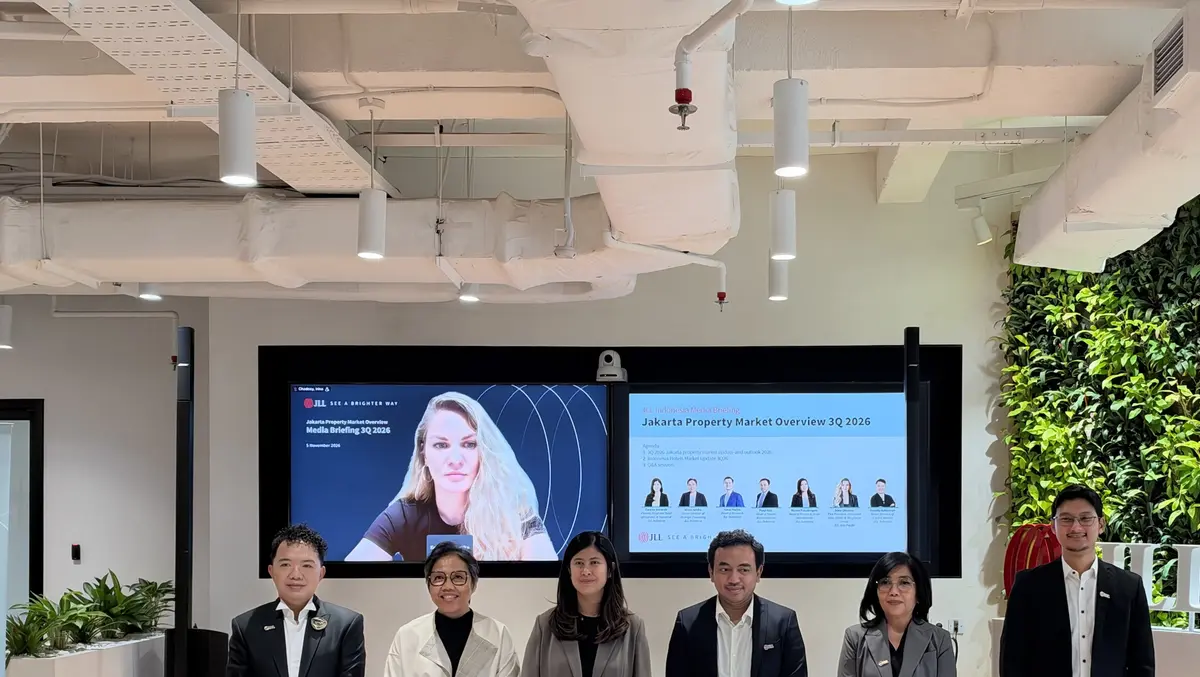
Jakarta office & logistics demand stays firm as rents rise
Fri, 20th Nov 2026 (Today)
JLL said office and logistics demand in Jakarta remained firm in the third quarter. It also reported slower condominium transactions, alongside stronger sales rates amid tighter supply.
In Jakarta's central business district, office occupancy reached 72%, while Grade A CBD rents rose 1.1% from the previous quarter. With no new supply entering the CBD, tenants were absorbed into existing buildings, with Premium and Grade A properties capturing most of the demand.
Grade B buildings returned to positive absorption after a negative reading in the previous quarter, while Grade C buildings continued to lose occupiers. Outside the CBD, technology companies led take-up, and North Jakarta was the busiest submarket.
"Office demand in Jakarta's CBD stayed strong through the first nine months of the year, and we expect it to continue to year-end," said Yunus Karim, Head of Research, JLL Indonesia. "Softer demand for Grade C buildings shows that the flight-to-quality trend, with tenants moving to higher-quality buildings, is still under way. In the condominium market, the absence of new project launches this quarter limited the supply of units, especially in projects still under construction, and that helped push the sales rate up to 83%."
The shift in office demand was most visible in top-tier space, where technology tenants overtook financial services as the main source of leasing activity. Net demand for Grade A CBD offices exceeded 25,000 square metres.
"Grade A offices in the CBD recorded consistent absorption in Q3 2026, with net demand of more than 25,000 sq m, and the largest share of leasing demand came from technology companies, marking a shift away from the dominance of financial services," said Panji Aziz, Head of Tenant Representation, JLL Indonesia. "AI, data centre and fintech companies were very active and accounted for the largest share of absorption, supported by steady activity in financial services. Demand for fitted-out and furnished space kept strengthening, as landlords offer furnished space or fit-out contributions and tenants look to cut capital expenditure. Rent growth is being driven by rising occupancy, especially in the Sudirman area."
Retail and homes
Jakarta's retail stock increased with the opening of a new shopping centre of about 16,000 square metres in East Jakarta, taking total supply to 3.2 million square metres. Net absorption was about 10,500 square metres, supported by food and beverage tenants, experience-led store formats and selective flagship openings.
Most new brands entering Jakarta came from Asia and typically worked through local distributors. Shopping centre occupancy held at about 86%.
In the condominium market, transaction volumes fell from the previous quarter, but the sales rate rose because no new projects were launched in Jakarta. Sales reached 83% of the 25,000 units tracked by JLL, with end users still driving purchases in both completed and under-construction projects.
The government-borne value-added tax incentive supported purchasing power, and completed units accounted for most transactions. In the wider Bodetabek area, one upper-segment condominium project was launched in Tangerang.
"The condominium market in Bogor, Depok, Tangerang (Bodetabek) is following the same trend as Jakarta, but we're seeing strong interest in some smaller projects with a limited number of units," said Milda Abidin, Senior Director, Strategic Consulting, JLL Indonesia. "Buyers are weighing the developer's name, established locations and developers' new concepts, such as small office/home office (SOHO) condominiums with mezzanine units at affordable prices. Low-rise condominiums aimed at end users are also in demand."
Logistics strength
The logistics and industrial market remained the strongest part of the sector, with modern warehouse occupancy in Greater Jakarta, or Jabodetabek, reaching 97%. Demand came from eCommerce groups, third-party logistics operators and manufacturers, including fast-moving consumer goods, healthcare and cosmetics companies.
That demand is lifting rents and land values in strategic areas, although final prices still depend on negotiations between landlords and occupiers. International groups were also active in the market.
"Logistics and industrial continue to perform as one of the most resilient segments of Indonesia's property market, with modern warehouse occupancy in Jabodetabek reaching 97% in Q3 2026," said Farazia Basarah, Country Head and Head of Logistics and Industrial & Capital Markets, JLL Indonesia. "Demand is coming from eCommerce, 3PL and manufacturing, especially fast-moving consumer goods (FMCG), healthcare and cosmetics, supported by expanding existing players and new brands, including significant participation from international players. That's pushing up rents and land values in strategic locations, though final deal values still depend on negotiation. This performance reflects Indonesia's potential: its demographics, a growing manufacturing sector backed by natural resources, and an accelerating digital economy."
Investor focus
In capital markets, Jakarta and Bali remained investors' preferred destinations. Most buyers focused on income-producing assets, while expected capitalisation rates were generally in the double digits.
Interest remained concentrated in offices, hotels, serviced apartments, retail and residential land. Alternative sectors such as hospitals, education facilities and data centres drew growing, but still limited, attention.
Bali continued to attract foreign hotel investors, particularly for development projects, joint ventures and branded residences, as existing stock remained scarce.
"While transaction activity across Indonesia has been limited this year, Bali remains a key draw for foreign hotel capital, with interest focused on development, joint ventures and branded residences given the scarcity of existing stock," said Irina Chadsey, Vice President, Investment Sales, Hotels & Hospitality Group, JLL Asia Pacific.
"Although global and domestic economic dynamics continue to temper property investment sentiment in Indonesia, the market continues to attract a range of investors, with Jakarta and Bali remaining the favourite investment locations," said Herully Suherman, Senior Director, Capital Markets, JLL Indonesia. "Investor interest remains concentrated in office, hotel, serviced apartment, retail and residential land assets, with growing but still limited interest in alternatives such as hospitals, education facilities and data centres. Looking ahead, we expect investor interest in Indonesian property to hold, with a focus on quality assets that generate stable income."